
For more than three decades, Cadmus has helped clients understand, characterize, and forecast evolving demand-side markets and changes in utility loads driven by customer adoption of efficient technologies, demand reduction, fuel switching, and distributed energy resources (DER).
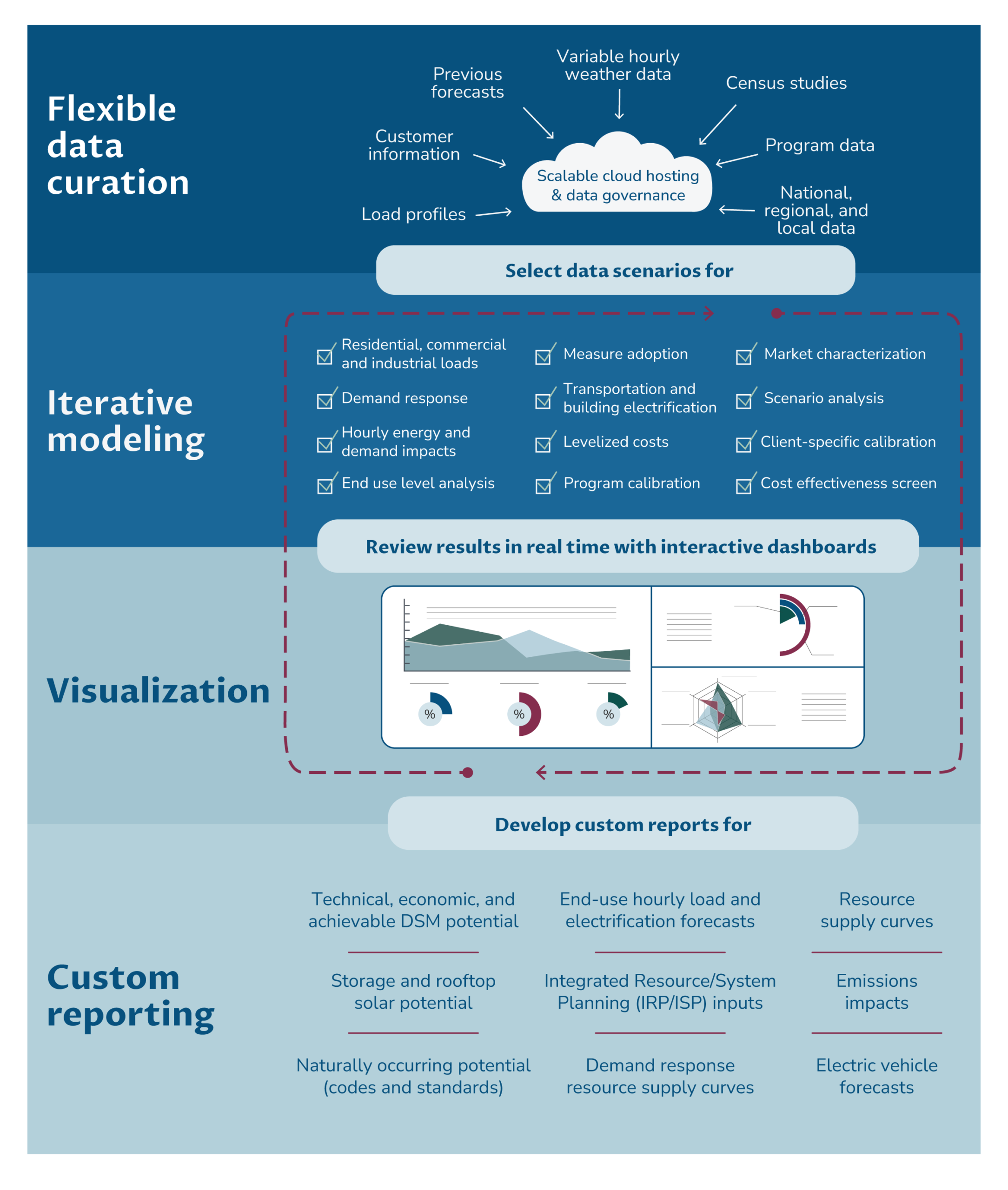
As an increasingly complex variety of DER equipment comes online and energy systems grow more interconnected, utilities need the tools and expertise to effectively manage resources and meet their regulatory obligations. The ability to synthesize large, diverse data sets—consisting of an ever-growing array of end uses, variable hourly weather data, load profiles, and shifting demographic profiles—is paramount to effectively forecasting long-term supply needs and meeting energy and climate policy mandates.
Cadmus designed and built Cadmus Nexus, our proprietary data modeling platform, to address these evolving challenges. Integrating advanced analytics and scalable cloud computing with our deep energy expertise, Cadmus Nexus provides utilities with flexible modeling capabilities to forecast supply resources at a granular level. Cadmus Nexus is built to ingest and synthesize large datasets from multiple sources to deliver accurate, relevant insights in near real time, enabling utilities to turn raw data into actionable decisions with greater speed and precision.
The next-generation Cadmus Nexus platform simulates base load as well as energy efficiency, demand response, and distributed energy potential at an exceptionally granular, hourly level. By combining data on customer usage, emerging technologies, market trends, and weather patterns, it provides a dynamic, real-world view of system performance and opportunities. The platform also supports analysis of potential impacts from demand growth in emerging areas like building electrification, fuel switching, electric vehicle adoption, and data center development, giving utilities a clearer picture of both current conditions and future scenarios.
Enhanced user-friendly capabilities simplify the process of interpreting and applying results, even as the underlying analysis grows more complex. Whether modeling climate-sensitive loads or assessing emerging technologies, the platform helps forecast end-use loads, evaluate equipment adoption, and understand how different resources will interact across a rapidly changing grid.
The platform brings many capabilities into one cohesive environment; its transparent cloud architecture is designed for flexibility and scalability, with a robust set of built-in analytical modules that can be readily customized for a client’s specific needs. Utilities can easily test different inputs and assumptions to see how changes affect forecasted results, offering the ability to explore potential scenarios and refine plans in real time through dynamic and interactive reports and dashboards.
By integrating multiple resource models, the tool covers base load forecast, energy efficiency, and demand response potential, storage and rooftop solar potential, transportation and building electrification, and industrial loads, all in a single environment. By modeling these resources together, utilities can assess load and savings impacts from a wide spectrum of scenarios that dynamically integrate all variables to account for interactive effects and provide a holistic view of system performance that cannot be achieved with a traditional, siloed approach. The result is a more robust planning model that responds to market shifts, weather variability, and long-term climate sensitivity.
With scalable modeling, integrated cost-effectiveness analysis, user-friendly interfaces, and high-resolution forecasting, Cadmus’ platform empowers utilities to make data-driven decisions based on alternative scenarios that reflect evolving technologies, regulations, and market dynamics.
