
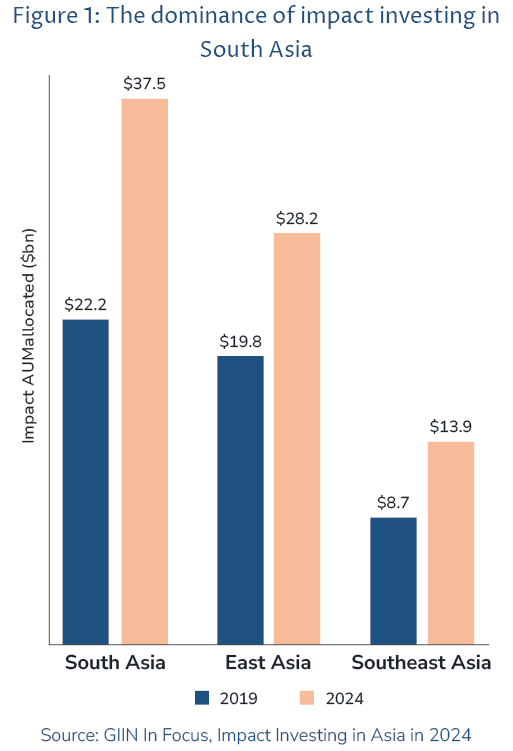
In the last two decades, the global investment landscape has undergone significant evolution, driven in large part by the growth of impact investing. Impact investing refers to investments made with the intention to generate positive, measurable social and environmental outcomes alongside a financial return.1 It blends financial goals with a desire to address pressing challenges, such as poverty, inequality, climate change, and access to education and healthcare.
South Asia is home to over 1.8 billion people although defined by diversity in terms of cultures, economies, and challenges. Despite this, countries such as India, Bangladesh, Pakistan, Sri Lanka, Nepal, and Bhutan also share commonalities including relatively higher levels of poverty than the wider Asian region, limited access to basic services, and environmental threats. Yet, despite these challenges, it has experienced impressive economic growth, burgeoning entrepreneurial ecosystems, and an increasing push toward a more sustainable development path. It is within this context that impact investing has emerged as a powerful tool for driving change.
Initially, impact investment was a niche concept, with few players and limited understanding of how to balance financial returns with social impact. However, as global awareness of sustainability, and the urgency of addressing climate change and inequality grew, so too did the interest in impact investment in the region (see figure 1). What started as a fledgling movement, primarily driven by a handful of pioneers, has now evolved into a significant sector attracting local and international investors, social enterprises, and donor and government support.
This short paper aims to explore the journey of impact investment in South Asia, starting from its early stages in 2005, to the present day, where it has become a powerful catalyst for addressing some of the most pressing issues of the region, and where, from a Cadmus perspective, it is likely to go in the near term.
