
Breaking apart a monolithic application into microservices has always been one of the hardest problems in software architecture. Teams spend months analyzing code, debating boundaries, and worrying about what they might miss. This whitepaper explains the core challenges of monolith to microservices transformation and introduces Cadmus Logic.AISM ReGenX, an AI-assisted modernization platform that transforms monolith code bases regardless of size or complexity. It walks through the five-phase methodology that underpins the platform. It describes how ReGenX analyzes code, discovers domains, plans migrations, defines services, and produces implementable microservices in a language and framework agnostic manner.
It also shows how artificial intelligence (AI) is integrated into key decision points and how human expertise remains central to the process. Rather than replacing architects, ReGenX augments their work. It automates deep analysis of existing systems, proposes domain boundaries, designs migration plans and generates detailed service definitions and code. At every step, humans stay in control and use the platform’s output as a starting point to make informed decisions.
At every step, humans stay in control and use the platform’s output as a starting point to make informed decisions.
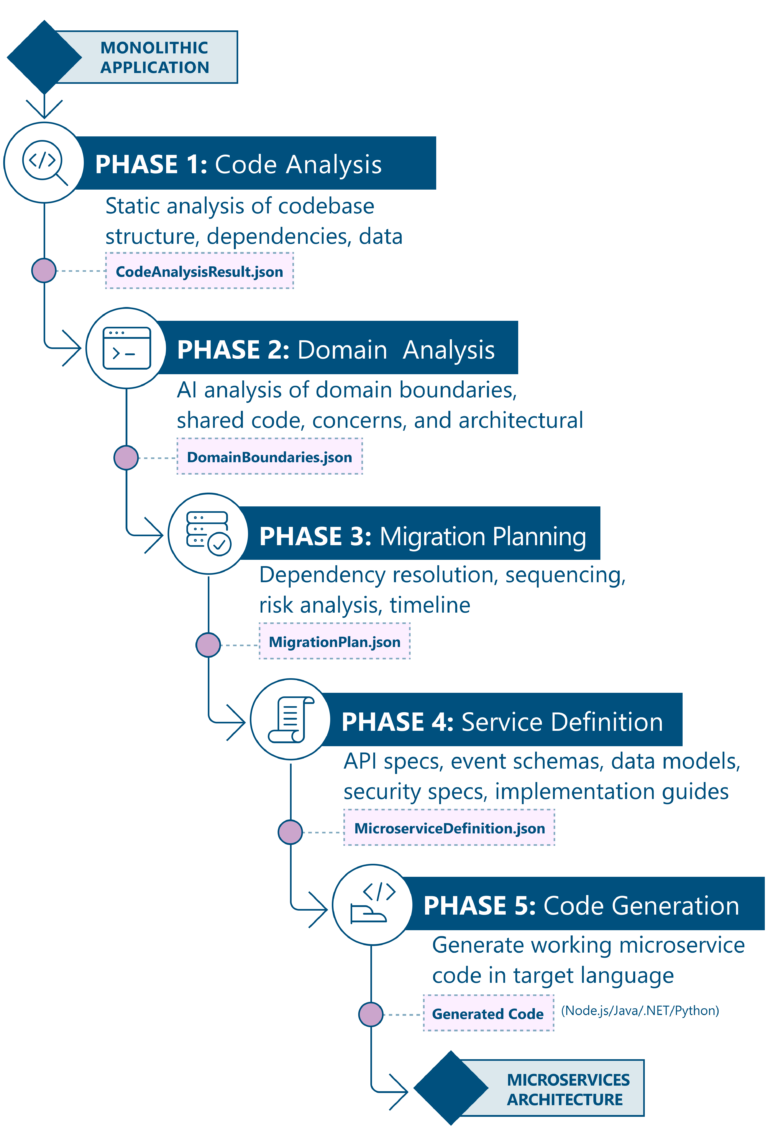
ReGenX is a modernization platform that implements a complete five phase approach for transforming monolithic applications into microservices. It connects deep static analysis, domain driven discovery, migration planning, service definition, and code generation into one coherent workflow.
The platform is built around a simple idea. A transformation of this scale should be guided by data and patterns, not just by intuition. Each phase produces structured, machine-readable output that feeds the next phase and that can also be inspected and refined by humans.
Within ReGenX, each phase is implemented as an engine that consumes and produces JSON-based artifacts. These artifacts capture the monolith’s structure, proposed domains, migration waves, service specifications, and generated code mappings. This design allows teams to run phases iteratively, adjust decisions earlier, and keep a clear trace of how the architecture evolves over time.
A transformation of this scale should be guided by data and patterns, not just by intuition. Each phase produces structured, machine-readable output that feeds the next phase and that can also be inspected and refined by humans.
To learn more about accelerating legacy modernization with the Cadmus Logic.AI ReGenX Platform, access the full white paper using the button below.
