
Cadmus supported the ramp up of one of the country’s most ambitious market transformation programs at a time when utilities and regulators are searching for scalable ways to achieve electrification, decarbonization, and equity goals. Through advanced market research, forecasting, and initiative development, Cadmus’ work with California’s Market Transformation Administrator (CalMTA) helped define how the energy industry transitions from incentive-driven programs to lasting market change.
California has led the nation in energy efficiency since the 1970s through pioneering appliance standards, building energy codes, and utility-funded efficiency programs. This long-standing commitment has kept statewide per-capita electricity use nearly flat for decades, generated billions in customer savings, and made energy efficiency a foundational resource for achieving California’s reliability, affordability, and decarbonization goals. As part of pursuing its clean energy transition target,[1] California needs new electrification technologies to be identified, developed, and brought to market to achieve widespread adoption. Such a process requires a team of experts to work in concert to effect change and transform markets.
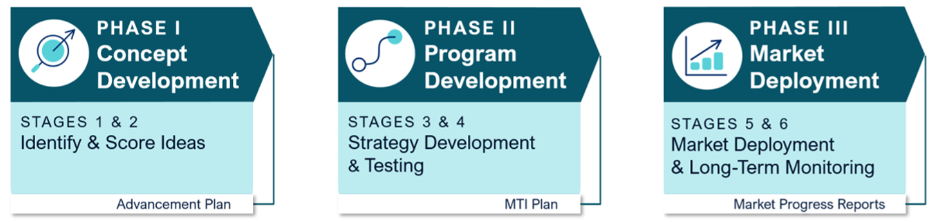
CalMTA was established by the California Public Utilities Commission (CPUC) for the purpose of accelerating and increasing the adoption of energy-efficient electric technologies in California. The process for MTI development is carried out in three phases: concept development, program development, and market deployment.
The MTI development process (shown in Figure 1) aligns with the CPUC’s comprehensive Market Transformation Framework adopted in Decision 19-12-021. In Phase I (Concept Development), CalMTA identifies and determines the qualifications of specific technologies before advancing to Phase II (Program Development), which aims to characterize the current state of California markets (e.g., identify barriers and potential opportunities for growth). Phases I and II are critical to managing program risk, maximizing resources, and providing grounded data to support development of an MTI Plan. At the end of Phase II, CalMTA files a request with the CPUC for approval of the MTI Plan to move forward to Phase III (Market Deployment).
Cadmus served as an expert technical consultant tasked with conducting in-depth market characterization studies, providing accurate technology assessments, and developing cost-effectiveness forecasting models to support preparation of CalMTA’s first MTIs. Cadmus, in collaboration with the Market Transformation Advisory Board (MTAB), played a vital role helping identify the feasibility of each MTI proposed by CalMTA; supporting Phase I and Phase II of each MTI’s development by establishing detailed research plans, helping develop pilot studies, and using a wide range of both traditional and innovative approaches to characterization California’s market for these initiatives.
Through an iterative process of identifying and scoring technologies for MTIs, Cadmus supported CalMTA to advance the candidacy of five emerging technologies from concept (Phase I) to program development (Phase II). These technologies and the market opportunities for each are briefly described below (see Table 1):
| Technology | Opportunity |
|---|---|
| Room Heat Pumps: Self-contained products that provide efficient cooling and heating for small spaces such as single rooms and small apartments/condos. | The majority of homes in CA use one form of cooling (e.g., central air conditioning), and one form of heating (e.g., gas furnace). These HVAC options tend to either use electricity inefficiently or they use less environmentally friendly fuels such as natural gas. |
| Induction Cooking: 120-volt options use efficient electric transmission and present as an upgrade over standard electric resistance cooking. | Nearly 70% of the CA residential market use natural gas ranges for cooking; however, they are significantly less efficient than electric cooking and pose a negative impact on indoor air quality and the environment. |
| Commercial Rooftop Units (CRTUs): High-performance HVAC rooftop units that go beyond federal efficiency standards by employing technologies such as variable speed compressors, heat pump technology, advanced controls, economizers, or remote monitoring. | About 50% of all commercial floorspace in the United States is conditioned (cooling and heating) by rooftop units. According to the Northwest Energy Efficiency Alliance (NEEA), efficient CRTUs can contribute up to 40% energy savings compared to standard units, which are still the predominate RTUs installed across the country. |
| Commercial Replacement & Attachment Window Solutions (CRAWS): Vacuum Insulted Glass (VIG) and Commercial Secondary Windows (CSW) are two window solutions that offer non-energy benefits such as noise reduction, glare reduction, thermal comfort, in addition to energy saving benefits beyond those offered by less efficient windows options (e.g., single pane). | Windows are infrequently replaced in commercial settings. Unfortunately, the majority of California’s building stock is equipped with inefficient single pane windows. However, as the building stock ages and the need for window treatment/replacement becomes more common, CRAWS present an optimal transition in settings such as municipal, university, school, and hospitals. |
| Residential Heat Pump Water Heaters (HPWH): Water heaters that use heat pump technology to heat water and are two to three times more efficient than conventional gas and electric water heating options. | Although HPWHs are significantly more efficient than standard gas and electric options, there is a general lack of consumer awareness of HPWHs. Currently less than 5% of water heaters sold in California are HPWHs; however, with increased awareness, incentives, and mitigation of barriers, the market for HPWHs has plenty of growth potential over the next decade. |
Once the technologies for the MTIs were approved to proceed to Phase II, the overarching research objectives for program development were to:
For each MTI, Cadmus developed a multi-faceted research plan that employed a wide range of methodological approaches. While there was significant overlap in methodology across MTIs, Cadmus tailored each MTI’s research plan with a unique approach based on the needs and current state of the market for each technology.
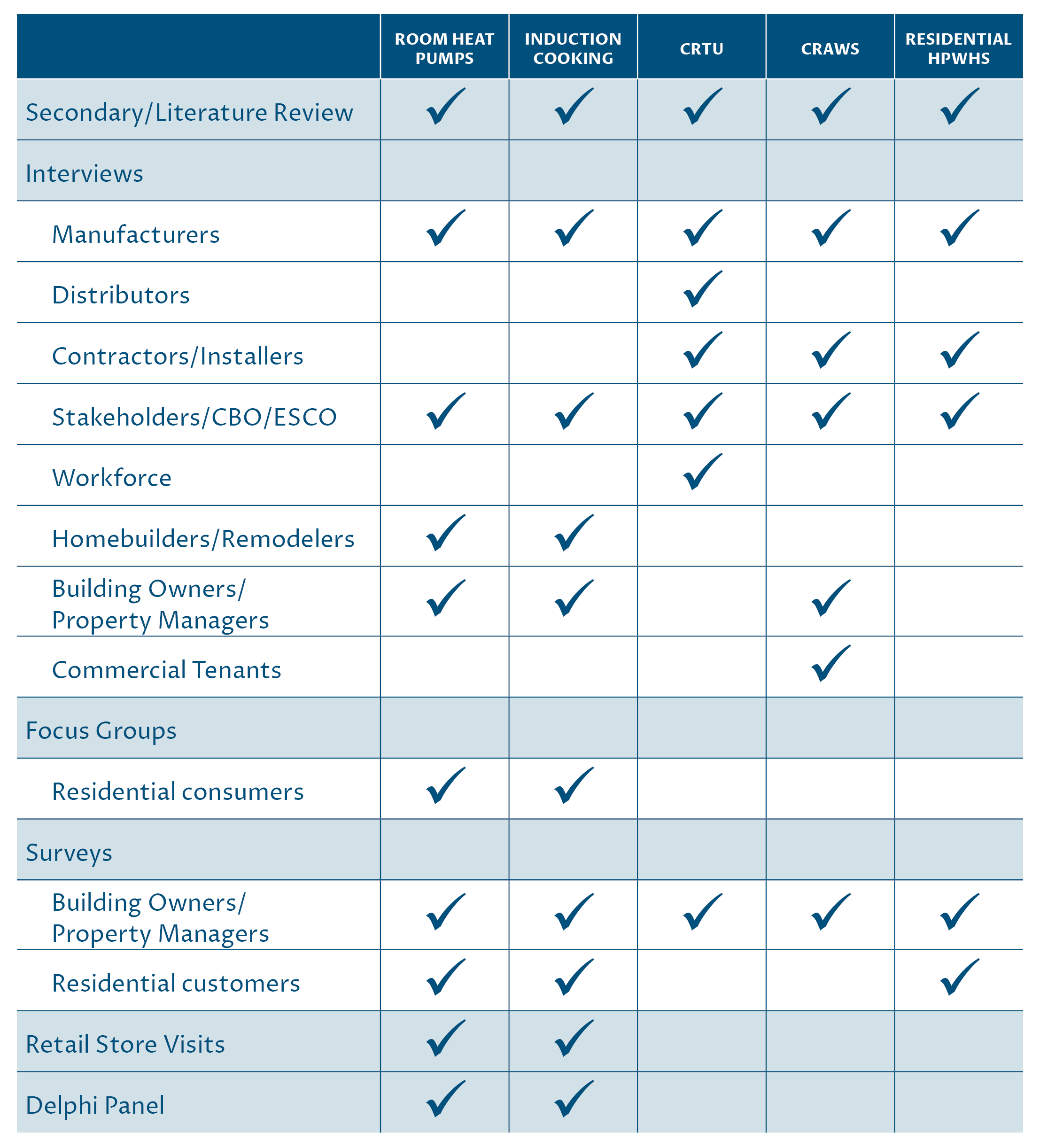
Cadmus performed in-depth secondary data and literature reviews for each MTI. Secondary data sets consulted to assess the current state of the market included sources such as ComStock, ResStock, Commercial Building Energy Consumption Survey (CBECS), Residential Energy Consumption Survey (RECS), and the California Residential Appliance Saturation Survey (RASS). Cadmus also conducted qualitative research such as in-depth interviews and focus groups and quantitative market research (i.e., surveys) with market actors across the supply chain depending on the focus and needs of each MTI. Additionally, Cadmus conducted retail store visits to assess the current state of marketing and promotion of products in different regions in California. To help gauge market trends and forecast future market adoption based on several estimated market conditions, Cadmus employed a Delphi Panel of experts for applicable MTIs. Table 2 summarizes the research Cadmus conducted for each MTI during Phase II.
Across the MTIs, numerous findings helped shape the development of each MTI Plan. Below, we highlight a selection of key insights that informed the planning process for each MTI.
Each of the MTI Plans that Cadmus supported development of are in various stages of market deployment. To stay up-to-date on these MTIs visit: Home – CalMTA.
As utilities and regulators across North America increasingly look beyond traditional resource acquisition programs toward lasting, market-based change, market transformation has become a critical strategy for achieving energy efficiency, electrification, affordability, and decarbonization goals. Cadmus helps clients navigate this transition by combining market research, strategic planning, forecasting, stakeholder engagement, and evaluation expertise.
Our team conducts market characterization studies, develops technology roadmaps and market transformation initiatives, quantifies market impacts through advanced forecasting and cost-effectiveness analysis, and designs evaluation frameworks that measure long-term market change. With experience supporting pioneering efforts such as CalMTA and market transformation initiatives in the Pacific Northwest, Wisconsin, and New York, Cadmus helps clients identify barriers, influence market actors, accelerate technology adoption, and create durable, self-sustaining market outcomes that persist beyond program incentives.
