Turning water strategy into action: takeaways from Colorado Water Congress conference
Collaboration, watershed resilience, and coordinated investment are essential to moving solutions from planning to implementation
Shared challenges in the Colorado River Basin
As part of Cadmus efforts to strengthen relationships in the water sector and better understand current challenges, water and climate finance leader Chris Wolff attended the 2026 Colorado Water Congress (CWC) Annual Summer Conference.
The conference brought together utilities, agricultural producers, irrigation districts, conservation organizations, nonprofits, policymakers, and other stakeholders from across Colorado to address a shared challenge: how to advance critical water, watershed, and resilience initiatives from planning into implementation. As a headwaters state, Colorado plays a critical role in shaping water outcomes that affect communities, economies, and ecosystems across the West.
Despite continued planning efforts and growing investment opportunities, an urgency to accelerate progress was a clear theme throughout conference discussions. Water providers and resource managers face increasing pressure from drought, population growth, watershed degradation, and changing hydrologic conditions. While favorable weather years can provide temporary relief, long-term challenges require sustained action and implementation.
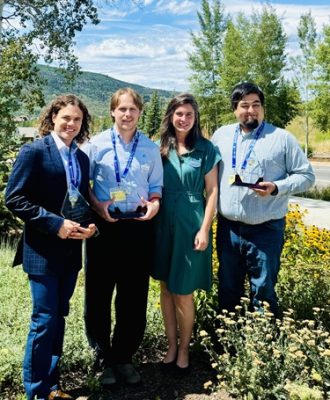
Chris Wolff, left, with fellow 2026 Colorado Water Congress award recipients Stephen Foster and Jake Kunugi, and Colorado Water Congress Executive Director Chané Polo.
Four priorities shaping long-term water resilience
Several conference sessions reinforced this message. Topics ranged from Colorado River management and agricultural water challenges to stream restoration, water-supply innovation, and local economic impacts associated with drought. One particularly notable session, Crisis Catalyst: Building Forest Economy, explored the connection between forest restoration, wildfire mitigation, funding strategies, and long-term water-supply resilience. The discussion highlighted how investments in healthy forests and watersheds can help reduce risks to source waters, improve reliability, and strengthen community resilience.
Across sessions and stakeholder conversations, four interconnected priorities consistently emerged:
Managing demand and protecting supply. Growing populations and economies place increasing pressure on finite water resources. Long-term water security requires strategies that balance competing needs and address the ongoing challenges of supply and demand.
Strengthening forest and watershed resilience. The conference’s “Crisis Catalyst: Building Forest Economy” session highlighted the connections between forest restoration, wildfire mitigation, funding, and water resilience. Healthy watersheds are essential to protecting water supplies and reducing risks to downstream communities.
Protecting source water. Proactive source-water protection can help safeguard watersheds, reduce risks to drinking-water quality, manage treatment costs, and support reliable service for communities.
Aligning capital with implementation. Advancing projects requires more than identifying needs. Public agencies, utilities, philanthropic organizations, and private-sector partners must coordinate funding and resources around projects that can be put into action.
Just as important as the technical solutions discussed at the conference was the recognition that successful implementation depends on collaboration. Water challenges cut across political, geographic, and institutional boundaries, requiring stakeholders with differing perspectives to find common ground around shared priorities.
This collaborative, implementation-focused approach aligns closely with the work Cadmus supports across the water sector.
How Cadmus helps communities advance water solutions
Cadmus brings together engineers, planners, hydrologists, finance specialists, and other experts to help communities advance water-resource solutions from concept to execution.
Our teams excel at connecting those elements that often remain disconnected: Technical analysis, policy development, funding and financing, community priorities, environmental resilience, and on-the-ground implementation. At a national, state, regional and local level, Cadmus helps our clients navigate those funding pathways, align partner resources, accelerate opportunities, leverage finance, evaluate outcomes, and define and develop practical programs and activities. Together we turn their ‘paper plans’ and ‘innovative ideas’ into fundable, actionable, and implementation-ready programs and projects. To read more about Cadmus’ work in this area, visit cadmusgroup.com/domains/water.
Water challenges are also closely connected to broader energy, infrastructure, and environmental priorities. That is where Cadmus’ interdisciplinary approach adds value. Rather than addressing these challenges in isolation, we bring together expertise from across the firm to understand how water decisions intersect with infrastructure, energy, resilience, financing, policy, security, and community needs. This allows us to help clients identify opportunities across sectors, align investments and partners, and build more comprehensive solutions that move faster from strategy to implementation.
As Colorado and the broader Colorado River Basin confront continued pressure on water supplies, the priority is clear: translate planning into action through coordinated investment, enhanced resilience, project implementation, and sustained collaboration.
Recognizing leadership in Colorado’s water community
The conference also provided an opportunity to recognize leaders helping strengthen Colorado’s water community. During the event, Chris received the Colorado Water Congress Award for Outstanding Contributions to CWC and the Greater Colorado Water Community in recognition of his service, collaboration, and leadership supporting water stakeholders across the state.
As a CWC POND (Professional, Outreach, Networking and Development) co-chair and program leader, Chris continues to convene utilities, agricultural interests, nonprofits, government agencies, and other stakeholders to advance constructive dialogue and collaborative problem-solving across the water sector. The recognition reflects both his contributions and the broader spirit of partnership that remains essential to addressing the Colorado River Basin’s most pressing water challenges.
Chris Wolff, left, receives the 2026 Colorado Water Congress Award for Outstanding Contributions to CWC and the Greater Colorado Water Community from former CWC President Christine Arbogast and Colorado Water Congress Executive Director Chané Polo at the 2026 CWC Annual Summer Conference in Steamboat Springs, Colorado.